


Table of Contents
- What Makes a Fashion Brand Truly Conscious
- Ethical Clothing Certifications to Look For
- Affordable Sustainable Clothing Brands Worth Your Money
- How to Build a Sustainable Capsule Wardrobe
- Repair, Upcycling, and End-of-Life Garment Solutions
- Styling Conscious Fashion for Professional and Casual Settings
- Frequently Asked Questions
Last Updated: September 2, 2026
What Makes a Fashion Brand Truly Conscious
A conscious fashion brand prioritizes environmental sustainability, ethical labor practices, and transparency throughout its supply chain. Most brands market themselves as sustainable without verifiable practices or third-party certification.
At Nature Works, we believe truly conscious fashion goes beyond greenwashing. It means making deliberate choices about materials, manufacturing processes, and worker welfare. The difference between genuine conscious brands and pretenders comes down to supply chain transparency: real brands disclose where garments are made, who makes them, and what conditions workers face. They measure and report environmental impact, from carbon footprint to water usage.
Beyond Greenwashing: Supply Chain Transparency
Supply chain transparency is the foundation of ethical fashion. When a brand traces every step of production from raw material sourcing to final manufacturing, you're dealing with something legitimate.
Look for brands that publicly document manufacturing partners by naming specific factories and publishing audit reports. Many now use blockchain technology or third-party verification to track materials from source to finished product, preventing outsourcing to unknown facilities with questionable labor conditions.
The most transparent brands share pricing breakdowns showing labor costs, material expenses, and overhead. This openness explains why conscious fashion costs more than fast fashion alternatives, you're paying for verified ethical practices, not marketing hype.
Ethical Manufacturing and Garment Worker Rights
Garment workers remain among the most exploited laborers globally (ilo.org). Ethical manufacturing ensures fair wages, safe working conditions, reasonable hours, and freedom of association for everyone involved in production.
Conscious brands typically work with facilities meeting or exceeding international labor standards set by organizations like the Fair Labor Association: living wages, healthcare access, safe facilities, and grievance mechanisms where workers can report problems without retaliation. Many also invest in worker development programs, offering training, educational scholarships, or leadership pathways, going beyond compliance to genuinely improve lives.
Ethical Clothing Certifications to Look For
Certifications provide third-party verification that sustainability claims are real, not just marketing.
Fair Trade Certification ensures workers received fair compensation and worked in safe conditions. Look for Fair Trade Certified labels on clothing tags and brand websites.
Global Organic Textile Standard (GOTS) verifies fabrics are made from organic fibers and produced under strict environmental and social criteria, tracking the entire supply chain from fiber production through manufacturing.
B Corp Certification indicates a company meets rigorous standards for social and environmental performance, accountability, and transparency through comprehensive audits and legal accountability.
Cradle to Cradle Certified evaluates products on material health, material reutilization, renewable energy use, water stewardship, and social responsibility, encouraging circular design thinking.
When shopping for conscious fashion brands for daily wear, prioritize items with at least one certification. Multiple certifications signal serious commitment across multiple dimensions.
Affordable Sustainable Clothing Brands Worth Your Money
Building a conscious wardrobe doesn't require spending a fortune. Many ethical brands offer quality basics at accessible price points by focusing on timeless designs and efficient production.
Brands emphasizing minimalist design and classic silhouettes offer better value than trend-chasers. A well-made organic cotton t-shirt lasts longer than three fast-fashion alternatives, lowering cost-per-wear over time.
Look for brands offering transparent pricing breakdowns showing material costs, labor costs, and overhead. Many achieve lower prices through direct-to-consumer models eliminating retail markups, or by partnering with efficient factories that use automation and lean production without cutting corners on worker welfare.
Start with basics: organic cotton t-shirts, linen pants, recycled denim. These foundational pieces form a sustainable capsule wardrobe and represent the best value in conscious fashion.
How to Build a Sustainable Capsule Wardrobe
A capsule wardrobe is a curated collection of versatile, high-quality pieces that work together across multiple seasons and occasions, eliminating waste by encouraging you to buy less and wear more.
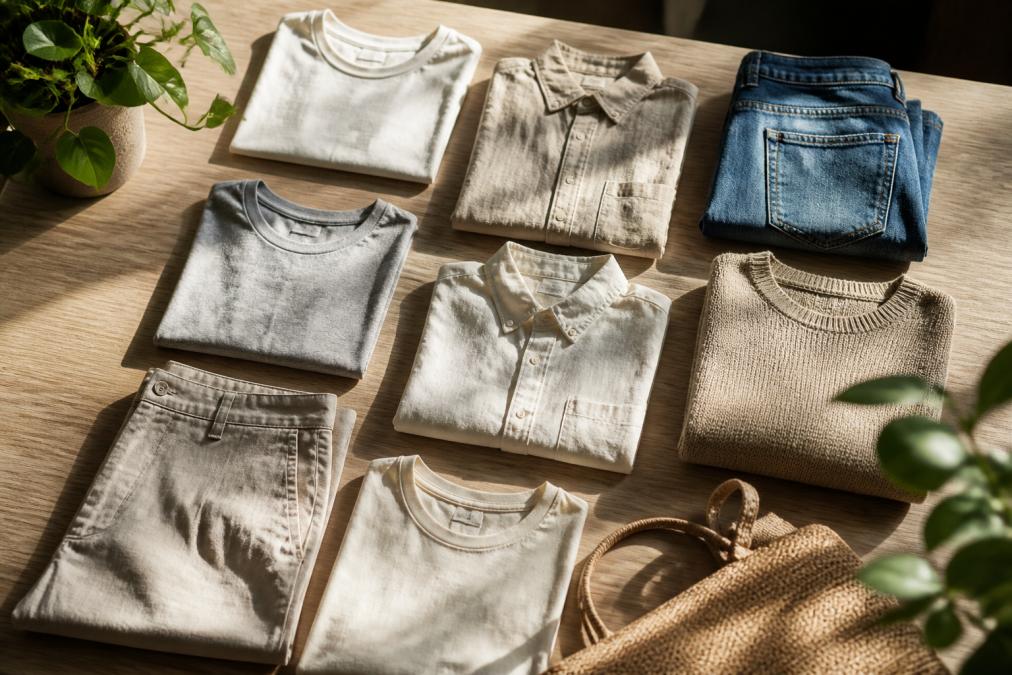
Start by identifying your color palette. Most sustainable capsules center on neutral base colors, black, white, gray, navy, beige, because they coordinate easily and never feel dated, reducing decision fatigue and ensuring pieces work together naturally.
Choose quality basics first: two or three well-fitting organic cotton t-shirts, one pair of well-made jeans (ideally recycled materials), neutral pants, and simple button-up shirts. Add layers like cardigans or lightweight sweaters that transition across seasons. Invest in one or two statement pieces reflecting your personal style from a conscious brand aligned with your values.
Before purchasing anything, ask: Will this work with at least three other items in my closet? Will I wear this a year from now? This intentionality prevents impulse purchases and reduces waste.
Calculating Cost-Per-Wear for Long-Term Value
Cost-per-wear reveals true garment value. Divide the purchase price by the number of times you wear it to understand actual cost per wear.
An $80 organic cotton t-shirt worn 100 times costs $0.80 per wear. A $15 fast-fashion shirt worn 10 times costs $1.50 per wear. The conscious fashion brand becomes the better investment. Most sustainable fashion experts recommend aiming for pieces with cost-per-wear under $1 for everyday items and under $2 for special occasion pieces.
Track cost-per-wear by noting purchase prices and logging how often you wear each item. After three months, you'll have real data about which pieces deliver the best value, guiding future purchases toward conscious fashion brands matching your actual lifestyle.
Repair, Upcycling, and End-of-Life Garment Solutions
The most sustainable garment is one you already own. Extending clothing life through repair and maintenance dramatically reduces environmental impact and cost-per-wear. When garments reach the end of their wearable life, responsible disposal completes the circularity narrative that conscious fashion brands promise.
Repair: Extending Garment Life Through Maintenance
Basic repair skills prevent premature disposal and are easier to learn than most assume.
Essential repairs you can do yourself:
- Sewing buttons: Requires only thread, needle, and 5 minutes.
- Mending seams: Hand-stitching a small seam tear takes 10-15 minutes and costs nothing.
- Patching holes: Iron-on patches work for quick fixes; hand-stitched patches are more durable.
- Replacing zippers: More complex but learnable through online tutorials.
- Fixing pilling: A fabric shaver ($10-$20) restores sweaters and knits without damaging fibers.
When to seek professional repair: Structural damage to seams or hems, zipper replacement on fitted garments, alterations for fit, and leather or specialized fabric repairs.
Many conscious fashion brands publish detailed repair guides on their websites and offer mail-in repair services. Check your favorite brands' websites for repair programs; this service is increasingly common among companies committed to garment longevity.
Upcycling: Creative Reuse and Transformation
Upcycling transforms worn or unwanted pieces into something new, keeping garments out of landfills while creating unique items.
Common upcycling projects:
- T-shirts to tote bags: Cut and sew a simple bag from an old t-shirt.
- Jeans to shorts: Cut at desired length and finish the edge with a simple hem.
- Worn sweaters to pillowcases: Measure, cut, and sew three sides; insert pillow form.
- Denim jackets from jeans: More advanced but achievable with basic sewing skills.
- Fabric scraps to patchwork items: Combine small pieces into new garments or home textiles.
If DIY upcycling feels overwhelming, many communities have upcycling workshops or local makers offering services. Some conscious fashion brands partner with upcyclers or offer upcycling kits with materials and instructions.
Donation and Secondhand Circulation
When clothing is still wearable but no longer fits your lifestyle, donation extends its life through someone else.
Donation options:
- Thrift stores (Goodwill, Salvation Army, local nonprofits): Free drop-off; tax-deductible. Items are priced affordably.
- Clothing swaps: Organize with friends or join community events. Everyone brings unwanted items; you leave with pieces someone else no longer needs.
- Online resale platforms: Poshmark, Depop, Vinted, and ThredUP allow you to sell used items, working well for higher-priced conscious fashion brands.
- Consignment shops: Some specialize in ethical or sustainable brands, paying you a percentage of the sale price.
Donation keeps garments in circulation for 1-3 additional years on average, significantly extending total lifespan.
Textile Recycling: End-of-Life Processing
When clothing is worn beyond repair, textile recycling breaks down fibers for use in new products, creating a circular loop.
Worn garments are collected, sorted by fiber type, and processed through mechanical or chemical recycling. Mechanical recycling shreds fibers and respins them into new yarn; chemical recycling breaks fibers down to molecular components for regeneration. The resulting material becomes new textiles, insulation, or industrial products.
Finding textile recycling in your area:
- Earth911.com: Enter your zip code to find textile recycling drop-off locations.
- Local waste management websites: Many municipalities list textile recycling options.
- Brand take-back programs: Increasing numbers of conscious fashion brands accept worn items for recycling, some offering prepaid shipping labels or physical drop-off locations.
- Textile-specific recyclers: Companies like Renewcell process worn textiles into new fibers sold to brands.
Recycled polyester and regenerated cellulose fibers from textile recycling are increasingly used by conscious fashion brands. When you buy a garment made from recycled polyester, you may be wearing fibers that were previously someone else's worn-out clothing.
Brand Recycling Programs and Circular Models
Many conscious fashion brands now operate take-back programs, making end-of-life disposal convenient. You mail worn items to the brand (some provide prepaid labels), the brand sorts items by condition, wearable items are donated or resold, and worn items go to textile recyclers. Some brands offer store credit or discounts as incentive.
A few conscious fashion brands operate rental or subscription models where you receive items, wear them, and return them for cleaning and redistribution, maximizing garment utilization and reducing new production needs.
The Environmental Impact of Responsible End-of-Life Disposal
Approximately 85% of textiles in the United States end up in landfills annually, where they decompose over decades and release methane, a potent greenhouse gas (the EPA). Synthetic fibers persist for 200+ years in landfills (peer-reviewed research).
By choosing donation, textile recycling, or brand take-back programs, you prevent this environmental cost. A single garment diverted from landfill to recycling or reuse reduces carbon emissions by an average of 7-10 pounds of CO₂ equivalent over its lifecycle.
This is why conscious fashion brands emphasize the entire lifecycle: buying less, wearing longer, repairing when possible, and disposing responsibly. Each step compounds to create genuine environmental benefit.
Styling Conscious Fashion for Professional and Casual Settings
Conscious fashion brands for daily wear work across every setting when styled thoughtfully. For professional settings, anchor your outfit around neutral basics and add personality through fit and quality rather than bold prints. A well-fitted organic cotton button-up shirt paired with tailored recycled denim creates a polished look signaling intentionality.
The beauty of a sustainable capsule wardrobe is that pieces transition seamlessly between contexts. That linen shirt works for client meetings, weekend brunches, and casual office days. Quality basics from conscious fashion brands adapt to your actual life rather than requiring separate wardrobes.
Consider your workplace culture when selecting statement pieces. If your environment is conservative, let your commitment to conscious fashion brands show through quality and fit. If your workplace values personal expression, pieces with nature-inspired designs create conversation starters without overwhelming your professional presence.
Accessorize intentionally. Shoes, bags, and jewelry from ethical brands complete your look while maintaining your values.
Building a wardrobe aligned with your values doesn't mean sacrificing style, comfort, or professional presence. The conscious fashion brands for daily wear covered here prove that ethical production and beautiful design coexist. Nature Works creates apparel that sparks conversations about environmental protection while delivering the quality and durability you expect from everyday clothing. Explore how intentional design choices and transparent practices can transform your wardrobe into a reflection of your commitment to planetary well-being.
Frequently Asked Questions
Q: How can I tell if a conscious fashion brand is truly sustainable?
A: Look for third-party certifications like Fair Trade Certified, Global Organic Textile Standard (GOTS), or B Corp status. Check the brand's supply chain transparency, reputable conscious fashion brands publish details about factories, labor practices, and material sourcing. Avoid vague language like 'eco-friendly' without specific evidence. Read customer reviews about durability and quality, since longevity is a core sustainability metric.
Q: Are conscious fashion brands more expensive than fast fashion?
A: Upfront costs may be higher, but conscious fashion brands often deliver better value over time. Calculate cost-per-wear by dividing the price by how many times you'll wear the item. A $60 ethical shirt worn 100 times costs $0.60 per wear, while a $15 fast fashion shirt worn 10 times costs $1.50 per wear. Quality construction, durable fabrics, and timeless designs mean conscious pieces last years longer, offsetting initial expense and reducing overall spending and waste.
Q: What ethical clothing certifications should I trust?
A: Fair Trade Certified ensures fair wages and safe working conditions for garment workers. Global Organic Textile Standard (GOTS) verifies organic fiber content and non-toxic dyes. B Corp Certification confirms the company meets rigorous social and environmental performance standards. Look for Cradle to Cradle or similar certifications for material innovation. These third-party audits provide accountability that self-claims cannot. Cross-reference certifications on the issuing organization's website to confirm legitimacy.
Q: Can I actually wear conscious fashion brands to professional settings without feeling awkward?
A: Yes, many conscious fashion brands offer minimalist, professional designs that don't sacrifice style for values. Look for neutral colors, classic silhouettes, and subtle branding that works in any office. The key is choosing pieces that reflect your personal aesthetic first, with environmental values as the foundation. Quality fabrics and tailoring ensure professional appearance. You don't need bold statements to wear your values; intentional, well-made clothing speaks for itself in any setting.
Q: What materials should I prioritize when building a sustainable wardrobe?
A: Prioritize organic cotton, hemp, linen, and recycled polyester for durability and lower environmental impact. Organic cotton eliminates synthetic pesticides; hemp requires minimal water and grows quickly; linen is biodegradable and long-lasting; recycled polyester diverts waste from landfills. Avoid synthetic blends when possible, as they shed microplastics. Check garment labels for material composition and research brands' sourcing practices. Natural fibers typically age better and biodegrade at end-of-life, supporting circular economy principles.